· Bryn Noel Ubald · Article · 3 min read
Spotlight on Steve Backshall’s Royal Arctic Challenge — IceNet in the Arctic
IceNet appears in feature length ITV documentary retracing King Charles' 1975 Canadian Arctic trip
Introduction
On 18 December 2025 at 20:30 (UK time), ITV1 premiered a new documentary, Steve Backshall’s Royal Arctic Challenge. Presented by explorer and broadcaster Steve Backshall, the documentary retraces King Charles’s 1975 trip to the Canadian Arctic and shines a spotlight on how much the region has changed over the past 50 years.
When & Where to Watch
📅 Thursday, 18 December 2025
🕣 20:30 (UK time)
📺 ITV1 broadcast (or) ITVX streaming
Update: Now available on ITVX for streaming.
The documentary includes rare footage and personal reflections from His Majesty, including his own under-ice dive from the original trip.
IceNet and Arctic Conservation
One segment of the documentary highlights the IceNet project, a collaboration led by the British Antarctic Survey (BAS) and The Alan Turing Institute. In the IceNet project we develop artificial intelligence based forecasting systems, learning from historical sea ice conditions to forecast the evolution of sea ice over days to months ahead. This helps us understand and anticipate changes that affect both the weather and life in the polar regions.
In the segment Dr Ellen Bowler (BAS AI researcher and lead author of the study) explains how IceNet forecasts could inform our understanding of the Dolphin & Union caribou migration, which is dependent on the timing and stability of seasonal sea ice. Dolphin & Union Caribou rely on a migration highway between Victoria Island and mainland Canada, but shifting freeze-up and break-up dates can alter their journey with deadly consequences. Ellen’s work involved close collaboration with regional biologists and conservation experts, including Lisa-Marie Leclerc and Amélie Roberto-Charron at the Government of Nunavut. Together they showed how IceNet forecasts can provide early-warning of autumn migration times, helping local teams protect migration routes from hazards such as ice-breaking vessels. If these ships traverse through the region during migration times they create gaps in the ice, which can have dire consequences for the caribou.
We hope that these predictive tools can help local experts manage pressures on wildlife in a rapidly changing Arctic, for caribou as well as other species such as polar bears, walrus and whales. To learn more about this research head to our earlier blog post where we dive into the full caribou case study and journal publication.
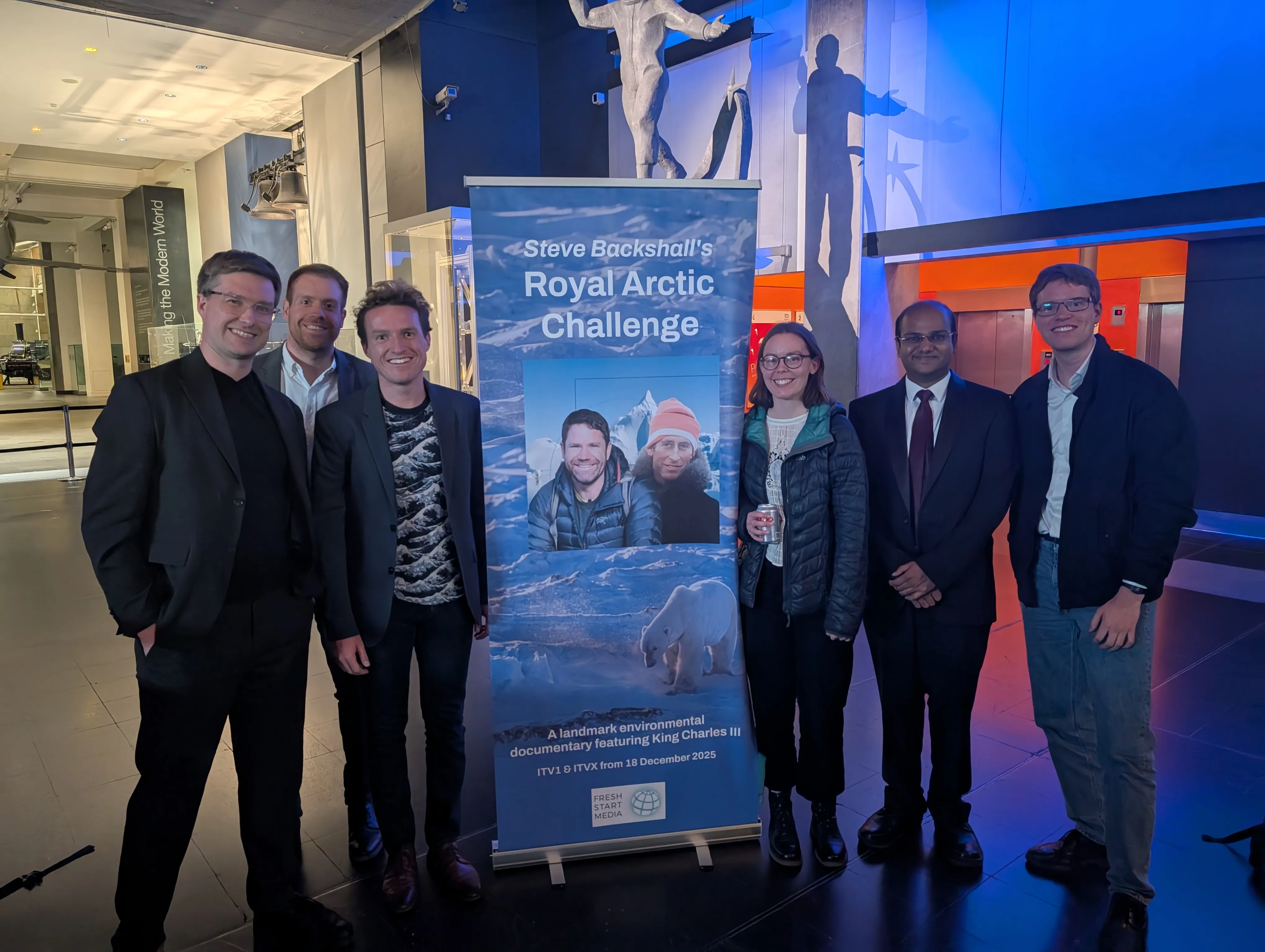
The IceNet team were kindly invited to attend the premiere of the documentary at the Science Museum in London. Thanks to Natascia, Marshall, and the rest of the Fresh Start Media team for involving us and shining a light on the impacts of climate change in the Arctic.

.Co8fmQq4.jpg)